During the second leg of our Salento trip, we moved our base from Otranto to Gallipolli, a historical charming little city where we found the perfect place to nest, a Palace decorated with exquisite taste.
While I stay in different hotels on regular basis, my hotel listing is not as broad. Simply because I try to keep it short and around truly remarkable places, like Palazzo Presta [WEB] a gem you can't miss in Gallipolli, particularly if you are a sucker for interior design like MOI.
Let's start in the sunny terrace, that doubles as breakfast spot. Options are limited but sufficient. There is a calm vibe, low key convos and educated people - completely the opposite I tend to experience around SE Asia hotels filled with groups of Chinese tourists. Every morning we would peel & cut our own fruits, kind of meditation for the day.
Sant'Andrea remains on top of all the spots we visited around Salento. Pristine waters, unknown swimming spots, great snorkeling and breathtaking rock formations along 500m coastline, with easy access to great food options like Babilonia or Confine Raw Bar - better for dinner.
I am not a foodie or even a person who cares much about food, yet I had this clear memory of a lunch at Babilonia when we visited Salento for the first time, 3 years ago. This small familiar restaurant in Sant'Andrea is the place for great friselle, a tradition in the south of Italy which is basically hard bread, put in water for a little while, topped with simple things like diced tomatoes, tuna or mozzarella.
Located right in between the amazing swimming spots in Sant'Andrea is the perfect pit stop.
Frisella is known as the bread of the Crusaders due to its ability to preserve over time, it favored the provisioning through the journey of the Christian troops. Frisella has always been a traveling bread. The origin of bathing it in sea water comes from the fishermen, who also used it as a base for fish or mussel soups, used during fishing trips that lasted several days. Maybe coz I'm a bit nomad, but this is hands down my summer go-to lunch.
For those who need a bit more (or would like to share) schiaccine, some kind of round sandwich in pizza base, is there to save the day. PSA: Enrique could not finish half, so we kept it for the day after, one triangle was enough as lunch for each of us.
If the weather is windy or you are up for an easier day, involving lettini e ombrelloni over a sandy beach and few spots to buy food and drinks, Baia dei Turchi is your pick. Like it is the case for many beaches in this coastline, sandy areas are surrounded by rocky ends where increased privacy awaits along with a spiky base. The choice is yours! This is quite a tranquile beach that may advisable for those who bring kids along.
Local recommendation is to park in 2 Palme parking. Just drive along the road till you find a sign with palm trees, where you can turn and park, map below.
What's perfect wrap to a long beach day in the south of Italy? Regardless of Enrique's attempts to get us all to do a MURPH, we opted for aperitivo at Skafé.
From the Moët in the fridge, through the unpretentious industrial seating arrangement amid Mediterranean wilderness, to the breathtaking views, this place is a winner. Just make sure to drop by. Here's a map, thank us later.
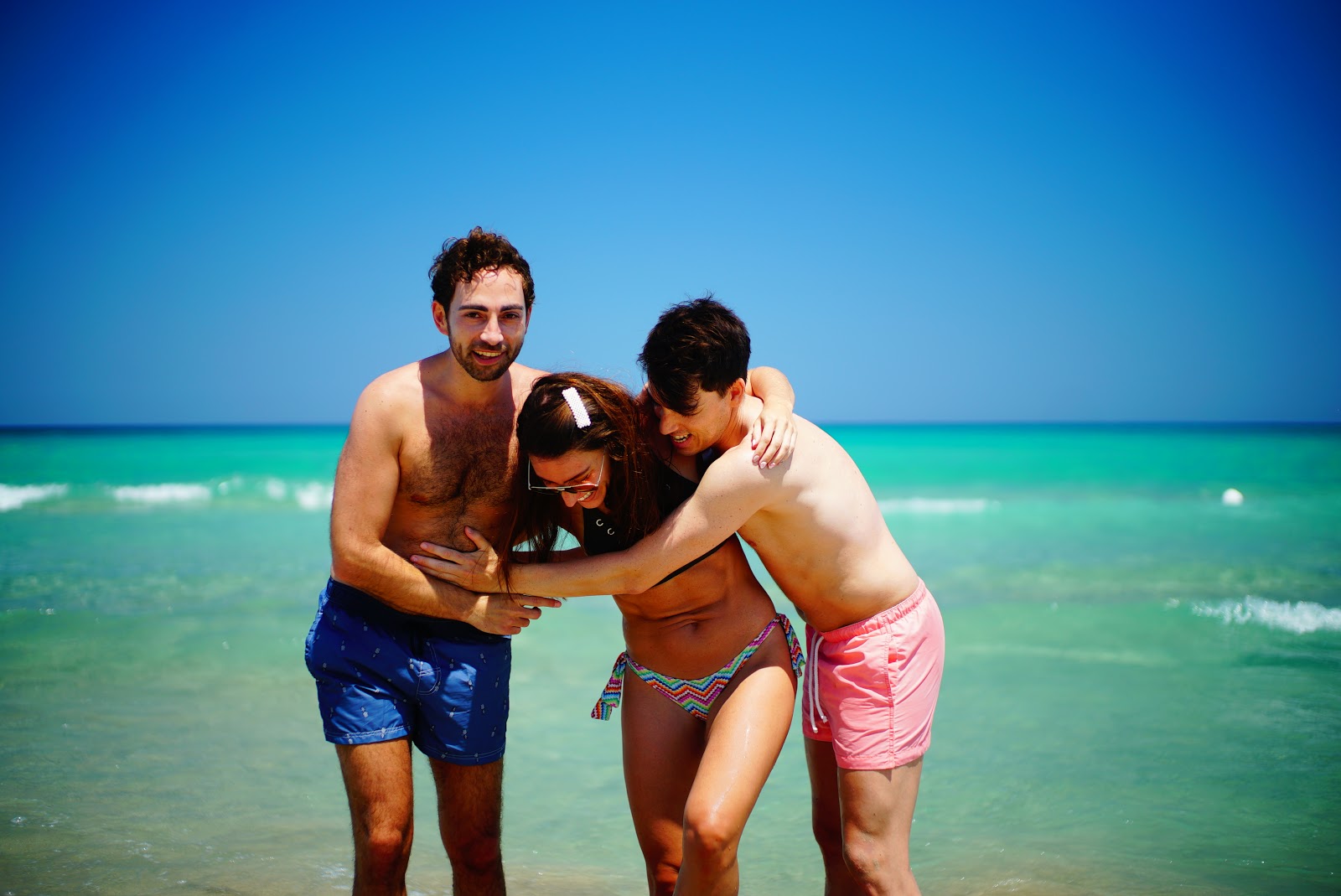
Porto Miggiano is one of the most memorable spots I've seen in the last years - despite various travels around the Caribbean and South East Asia. It's the almost hidden location, the vibrant azzurro, the wilderness (you'll have to bring water, food and anything else you need to survive, as there's literally nothing but pristine waters and few rocks to lay on down there) that make it so magical. As you access through broken stairs and fences, down to that bunch of rocks half covered by concrete, you wonder about the background story.
Lucky us we had Fabri. Friend, Salentino native and guide during those days, he explained that while the original plan was to build some saltwater pools, environmentalists managed to stop it, leaving the spot half finished but notoriously amazing, just like many other things in Italy I have to say.
There are a bunch of parking spots near the beach, maybe the easiest is to drive towards 19 Summer Club, park and walk towards Porto Miggiano Beach in the map below. Bring water, sunscreen and snorkeling gear, the rocks are home to a bunch of cool fishes.
It's almost one year without writing... Vacations, chained with business trips, weekend work & other kind of killed my inspiration... Till I went back to Salento. This post is dedicated to Fabri "born & raised in Salento". Your recommendations made it truly magic, we will be forever thankful for that. Together with Daniel, you guys were magical hosts for this trip and I look forward to new experiences together, maybe on this side of the World?
WHY
Italy is a boot where Salento is the heel. Located at the south of Puglia region which is responsible for more than 60% of the olive oil produced in Italy, this little region is surprisingly unknown. We all end up there by seeing "someone else's" vacation pictures & asking about the location. I was lucky enough to have a native from Salento in my closer group of friends, that hosted us during a magical escape in 2016. I swore to come back with Enrique and it took me 3 years, but we did it.
Think of unexplored pristine rocky beaches, simple yet delicious Italian food, tiny little charming old villages offering dreamy stays at revamped Palaces and lack of gentrification. Great quality of experience at an incredible price. The kind of place where you drive along the coastline, spot some rocks, pull over the car and dive to find out that Coral Reefs are well and alive in the Mediterranean sea.
WHEN
Preferably in June, July, September better than August, which can be quite packed by national tourists and locals back to their hometowns.
WHERE
We tried both coasts during our vacation, spending 3 nights on each:
- Relais Valle dell'Idro [WEB] in Otranto, our base while visiting the East coast. Highly advisable, has private parking.
- Palazzo Presta [WEB] in Gallipolli, our base while visiting the West coast. Absolutely loved the place.
HOW
We flew to Brindisi airport, rented a car and drove directly South, missing to see some of the most picturesque villages highly recommended by our local friend (and surprisingly also the guy from the rental car) Lecce, Polignano a Mare, Alberobello & Ostuni. If you have time, may be worthwhile staying in Lecce to explore them.
Highly recommended to book the car in advance, using SIXT or another major company - check whether they have counter at the airport. It is pick up service, make sure you can call once you land to confirm the pickup point - which is sometimes not clear. Driving in Italy is an interesting experience despite being a seasoned Spanish driver with varied experiences like US or South Africa, just be mentally prepared for it. While safe, generic precautions such as not leaving any valuables or luggage in the car apply. The public parking in Gallipolli is the weirdest thing ever. Card payment doesn't work, note changer doesn't work, there is no free spot, but yet you can park on the "forbidden" lines with a 2 hour validity ticket and find your car the day after.
WHAT
We spent a total of 6 days in Salento, 3 nights in Otranto & another 3 in Gallipolli:
- We reached the Otranto hotel quite late & went straight to bed
- Full day in Porto Miggiano
- Full day in Baia dei Turchi
- Full day in Sant'Andrea,
- Coastal drive from Gallipolli to Santa Maria di Leuca - the southernmost tip of Italy
- Coastal drive from Gallipolli to Punta Prosciutto, stopping in Santa Maria al Bagno on the way back
- The morning after, flight to Rome for our last 2 days in Italy.
The souvenir I brought is home perfume from a brand called Salentum, that has this Negroamaro fragance that reminds me so much of the Dr Vranjes one I used to buy in Japan.
1. Porto Miggiano
This small sandy beach nearby some concrete-covered rocks is a pristine spot preserved thanks to environmentalistas action. The plan was to build some salt-water pools but after demonstrations, everything got stopped leaving it as it is. A hard to reach, crystal clear spot to spend a lovely day tanning and snorkeling. Bring water & food, there is nothing. We left early to catch a long aperitivo at the uber cool Skafè al Casotto, followed by dinner at the fusion Laltrobaffo - pick the raw fish platter, near castillo Aragonese in Otranto.
2. Baia dei Turchi
The wind was quite strong, so we made the exception to spend the day at a sandy beach. The rule in Salento is simple, sand = crowded lettini e ombrellone while rocks = snorkel & privacy. Still it was quite convenient to park at "Due Palme" and be able to buy cold drinks instead of carrying them. Then we went for icecream-aperitivo to the best spot: Dentoni where both drinks AND sweets are available, how amazing is that? After changing clothes, dinner was waiting at Confine a hidden gem in Sant'Andrea, where you can find great fish and pizza. I really appreciate this Italian thing of "you can have it all" restaurant - very much in contrast with the uber narrow menu of traditional restaurants in Japan, where they only do one thing to perfection - it just makes it so simple to cater for a group.
3. Torre Sant'Andrea
If there was an iconic picture of Salento, it would probably be the arch of Torre Sant'Andrea. This is ironically close to Fabri's base in the coastline and also what got clearly imprinted in my memories 3 years ago. But the secret is to explore the other side, where magical rock formations & amazing snorkel awaits. When you are tired to check the fish banks, drop by lunch at Babilonia serving friselle - my absolute favourite holiday lunch, dry bread, tomato & tuna; simple, healthy & tasty! - and humongous schiaccine. This was our last day in the East side, so we kissed the guys goodbye & drove to Gallipolli.
4. Santa Maria di Leuca
We drove all the way to Punta Ristola in Santa Maria di Leuca, which is the southernmost tip of Italy to take some pictures where the Adriatic and the Ionian sea meet. We were a bit disappointed to find it was a cliff rather than a rocky beach. While we were about to drive out of the village, we spotted a German couple carrying snorkel gear downhill and decided park and follow them, to find the most amazing secret beach (understood as bunch of rocks to stay & snorkel from to the purest coral ever seen in the Mediterranean). We eat leftover schiaccine with some granita from the chiringuito back on the road & drove back to Gallipolli. On the way, we stopped at Pescoluse aka Maldive del Salento, to find it overcrowded & packed with ombrellone-lettiniers. I told you, sand is no good. Sunset Negronis served on sunset at the rooftop bar of Palazzo Presta (aka our hotel) were the sign of a great evening down the line. Following the mini-guide full of hits from the hotel, we went to Skafud Mare, for the most amazing dinner of the trip featuring tuna tartare with friselle, burratta & fondente.
5. Punta Prosciutto
Another drive, this time up North. I convinced Enrique to go the longer route along the seaside, so we could see potential places to stop. Once we reached our initial objective, the Punta Prosciutto, we saw the long sandy beach and drove further till some rocks we could spot at its Northernmost end. We were less than 10 people, doing what we could to stand somehow on the spiky rocks, but still the snorkeling was amazing - this time we brought the GoPro, you can see the amount of fishes and healthy coral in the video below. On the way back, we stopped at a bathing spot near Oasi Quattro Colonne (interesting place with 4 towers) in a village called Santa Maria al Bagno, as the sun was setting I was a bit cold - perks of living in Bangkok - and enjoyed the sunset instead of going for a swim. Back in Gallipolli, we went for our last Salento aperitivo and then had dinner in La Vinaigrette, another recommendation from Palazzo Presta guide that turned out a success.
People often ask me about recommended places for sushi in Tokyo.
If they are after a top-notch experience they better check the Michelin guide, but for some bang-for-the-buck without luxury but with variety and freshness, I can recommend Katumidori the kaiten sushi of sushi midori - that translates literally to green sushi. There are many branches, but most likely the one in Yokohama or in Seibu Shibuya A (gourmet zone located at floor 8 of mall A), here is the mapto an Italian restaurant in the same floor as I just realized that Google Maps pin for Katumidori was WRONGLY marked.
I'm not a foodie, but this place always makes it into the stops whenever I return to Tokyo. This time was more special because of being the first time for us to come back together since 2014, of course we booked time for a lunch here!
The ordering system is simple and straightforward:
Pick from the belt (kaiten)
Pick with iPad (easy picture menu) and get your order by waiter if you are in counter sit or by cute-train if you are in table
Below come some or our favourites - how about yours?
Mental note - never grow up While Tokyo is often known as the city that never sleeps, having experienced its nights I would instead call it the city where anything can happen, you know where nights start but you never know when, where and how it will end.
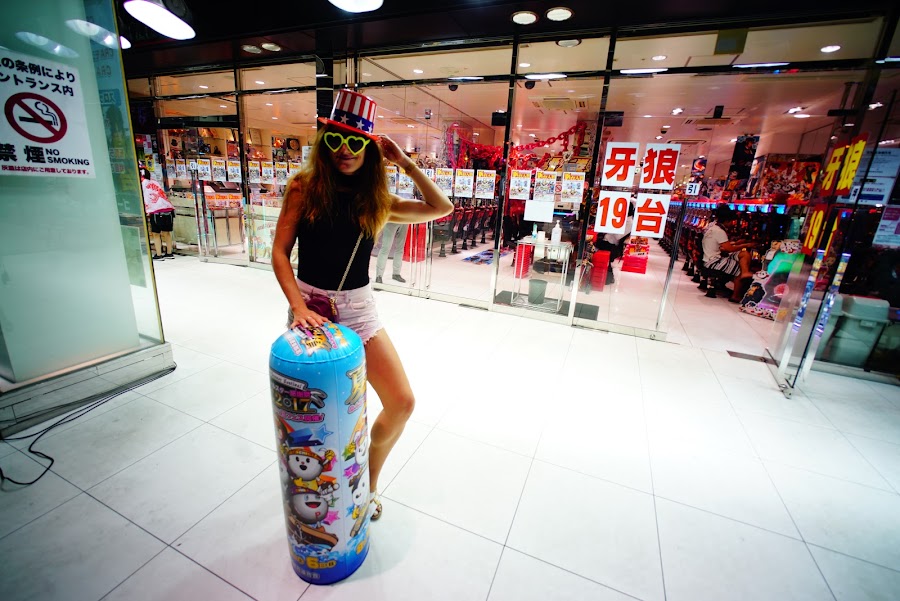
After 17km walk around Kamakura, nearly 3h train ride and a yummy izakaya dinner we were pumped enough to check out the teen side of the night, with a walk around Shibuya's main attractions. At night. You can see the look of the pachinko fella pictured below, it did not seem like a good idea.
ロカビリー (Ro·ka·bi·rii)
Me atrevería a decir que los ロカビリー (Ro·ka·bi·rii) son la atracción favorita de Enrique en Tokyo, desde que los vio por primera vez bailar allá por la primavera de 2012. Aunque el rock no sea lo mío, hasta a mí me hacían gracia, quizás por lo inesperado de la situación: Quién hubiera dicho que nos íbamos a encontrar una panda de rockeros de mediana edad a la entrada de Yoyogi, el parque en medio de Harajuku aka corazón teen de Shibuya?
Resulta que la costumbre venía de lejos. En los años 70-80, se puso de moda bailar en las calles de Harajuku - movimiento conocido como hijos del bambú「竹の子族」- estableciéndose grupos de todo tipo, incluidos los rockabillies. Sin embargo, esto se prohibió en 1998 con lo que se desplazaron a la entrada del parque de Yoyogi donde estos grupos con edades entre los 10-50 años mantienen viva su pasión todos los domingos.
Pero el año pasado, sólo vimos chaquetas de los Strangers - estarían los demás de vacaciones? O simplemente se habrán disuelto? El caso es que sigue siendo un vicio volver a verles bailar y echarles fotos, repartiendo chulería al ritmo de temazos del rock'n'roll Japonés.
Si te entusiasma el tema, échale un vistazo a los Lebels aquí y me comentas si también son tus favoritos! Si al final eres más team Strangers, allá va un vídeo de uno de sus miembros!
If you think you are too old to rock 'n roll, then you are.
Despite having royal temple grade (the highest) Wat Suthat is relatively unknown and much less transited than neighbouring temples located closer to the riverbank, started by King Rama I in 1807, it's quite nice to visit given the lack of crowds. If you ask me, this is how temples should be explored.
Wat Suthat features Thailand's largest main chapel, where Phra Si Sakayamuni aka the largest (8m high) surviving Sukhothai style Buddha (from the 14th century) resides. It also features 28 chinese style pagodas surrounding the main building, as a representation of the 28 buddhas born in this World.
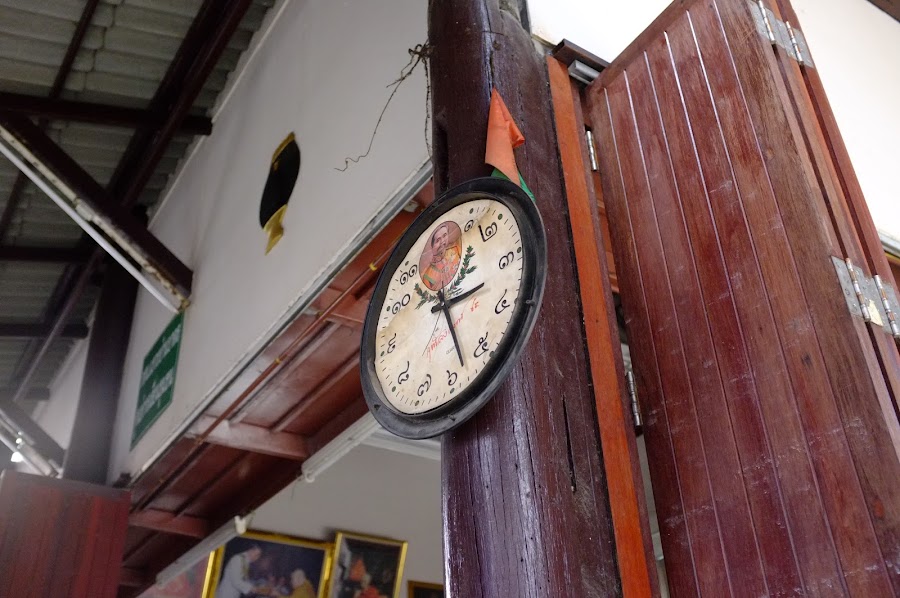
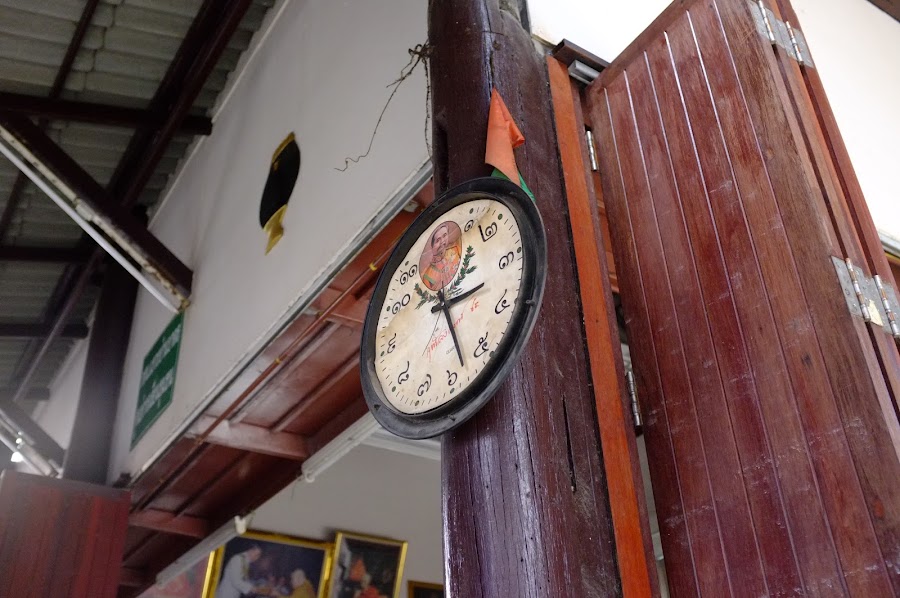
The most memorable piece though are the huge mural paintings that decorate the walls surrounding the Buddha and the use of Western style elements, like the clock above. Murals are extremely mesmerizing to me, as the technique used to connect different stories across the wall into a narrative thread seems nearly magical.
Jataka
Mural paintings are a common element on the walls of Thai temples and palaces. While we see the Ramakien myth depicted in the walls of the Grand palace, it is also common to have the paintings capture one of the 10 jatakas, or stories describing the ten final lives of the Bodisattva who would finally become Buddha. These are known in Thai as dasajāti jātaka ทศชาติชาดก. The last 10 lives capture the main virtues of renunciation, vigour, benevolence, absolute determination, insight, morality, patience, equanimity, reality and generosity. Usually the lower parts of the murals, capture Jataka scenes, while the life of the Buddha is depicted higher up.
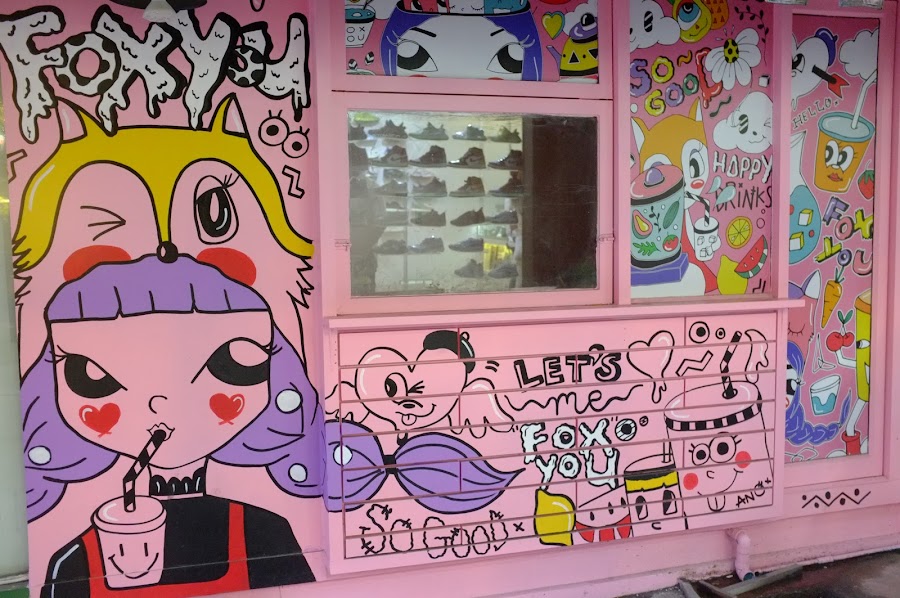
English Soi Ari 4 is deeper in the neighborhood but displays a large variety of eating and staying options for those daring to explore that far. We have tried places though with varied results. Rokukyu69, the Japanese restaurant with the colorful wall turned out to be cheap, but not so good - somehow they thought that frying gyozas was cool, so I would not recommend it. On the bucket list are Pakalolo the tiki bar and Yuzawa another Japanese that seems to be of Chinese influence due to the variety of hotpot options - not sure how keen you are on soup considering the heat.
On the caffé side we have Porcupine - nice for hanging out, but with disappointing menu heavy on most-likely-warmed-up-pasta and little else, Bar storia del Caffé- very hyped, good meals if you can handle the extremely slow velocity.
I noted a couple of hotels for the stay bucketlist Josh and Rest which you may want to consider if you are after a chill local time in Bangkok.
Spanish Soi Ari 4 está bastante escondido y quizás por eso, no esperas encontrar semejante variedad de restaurantes, cafeterías, bares, hostels y hasta un SPA. Al comienzo de la calle aparecen Rokukyu69, un Japonés cuyo mural es bastante mejor que la cocina - por alguna razón pensaron que freír las gyozas era una buena idea, seguido de Yuzawa, que todavía no hemos probado; Porcupine un café con potencial para beber algo - pero no comer salado; Pakalolo un bar Tiki con un concepto cuando menos sorprendente y un par de hostels que pintan bastante bien, Josh Hotel y Rest.
La estrella de la calle se reserva para el final, sin duda Bar storia del Caffé es un hotspot super instagrameable, donde se reúnen cámaras y huevos escalfados a partes iguales. Quizás sea una buena opción para empezar el día antes de emprender una dura jornada de compras en Chatuchak.
Bangalamphu, the place of Lamphu Bangalamphu is the old Bangkok encapsulated in a leafy district.
The infamous Khao San road may be the most known attraction in the area, it is definitely most interesting if you ask me. When general Chao Phraya took the Taksin down and established the capital as Rattanakosin, moving the city proper to the river's eastern bank(click to read more about the history of Indochina, where Siam and Khmer empires succeeded each other). He had new fortifications built around these boundaries and dug new moats and canals (Khlongin Thai) that give Bangkok the Asian Venice vibe, which are still in place today. Within these boundaries we find a myriad of monks, temples, artisans and monuments worth visiting.
Today we take a walk around the other Bangalumphu shown in this map. I walked from Nathional Monument BTS, I would rather recommend you to take a tuk-tuk or taxi from there instead:
Tucked away towards the end of Ari soi 4 (map) is the extremely popular Bar storia del Caffé, which shares location with a very interesting spa called Calm, which is in my bucketlist.
The decoration as great as the fare they serve. Staff is a bit slow - good things take time seems a recurrent motto in Thailand - but the dishes are well worth it. If you are a sucker for bread, make sure to order the extra toast as some brunch plates (eggs benedict, as an example) come without it. As usual in Asia, if it ain't in the picture, then it ain't included.
I felt brave and ordered the sunny side eggs, which were thankfully NOT fried but grilled #beyondhappy. It gets extremely packed during the weekend so you may have to queue, but it is anyway quite interesting to observe the army of blogger-influencer wannabes taking shots at the door and capturing the food, even if when it eventually turns out to be a shared dessert among 5 people. Price wise is on the expensive side of Bangkok, but still ok for foreigner I guess - less than 12EUR for the eggs, a coffee and some soda water.
If you are staying in any of the hostels in the very same street, sincerely recommended option for a fancy breakfast! Someone at work recommended this place, guess it is some kind of celebrity hotspot, based on the continuous attention and photography it gets from local girls.
Siam square
Siam Square's first buildings were constructed in 1970 on land belonging to Chulalongkorn University, as a way to provide rental income for the University. Streets West of Siam Square One shown in the map below are a labyrinth of local fashion, high quality counterfeit, cheap accessories, tailors, cafés and restaurants, particularly popular among teenagers.
I don't go shopping much, but sometimes I drop by Siam square - so far I've come back with some cool clothes for dance class and more goodies from Hamburger Studio, as they had stuff that never made it to EmQuartier. I have to say I find this area way more exciting than the surruonding malls (both Central World and Siam Paragon are very confusing to me), check the streets west of of siam square one out and let me know!
Dāna
La práctica de cultivar generosidad es uno de los pilares del Budismo. Al desprendernos de las posesiones materiales no sólo nos alejamos del sufrimiento que conllevan los impulsos adquisitivos sino que además tenemos la oportunidad de mostrar nuestro respeto hacia los monjes que muchas mañanas te encuentras en las esquinas de Bangkok, sentados con su bol, esperando a que alguien deposite comida - ojo! el dinero no es una ofrenda aceptable.
Bàht
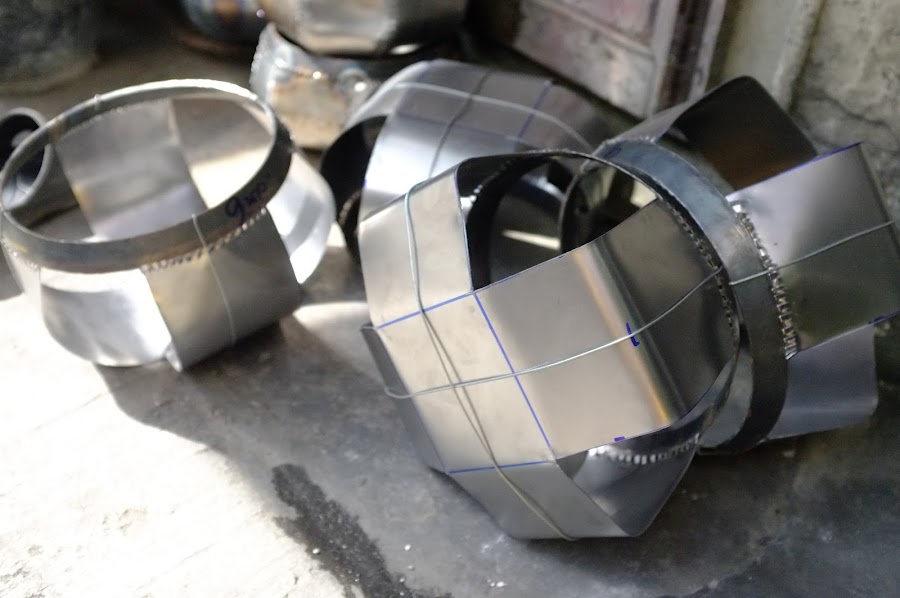
El bol que tradicionalmente usaban los monjes budistas para recoger limosnas tiene una historia que se remonta al comienzo de la Tailandia moderna con el reinado de Rama I (1782-1809) cuando el rey estableció 3 pueblos de artesanos especializados en esta labor. El bol de limosnas tradicional está hecho con 8 piezas de metal, que representan el Noble Eightfold Path o noble camino óctuple aka los principios de la fé budista, que se agrupan bajo 3 categorías:
Sabiduría (paññā)
Visión (dṛṣṭi • diṭṭhi): Entender que las acciones y pensamientos tienen consecuencias más allá de la muerte.
Intención (saṃkalpa • saṅkappa): Cuando alguien abandona sus pertenencias y adopta la vida de monje, lo hace renunciando a la sensualidad, la maldad y la crueldad.
Conducta ética (sīla)
Discurso (vāc • vācā): No mentir, no hablar con malas palabras o por detrás de la espalda.
Obra (karmānta • kammanta): No matar ni herir a nadie, no robar, carecer de deseos materiales y sensuales.
Medio de vida (ājīva • ājīva): Alimentarse de limosnas, poseer únicamente lo esencial ara sobrevivir.
Entrenamiento de la mente (samadhi)
Esfuerzo (viāiāma • vāiāma): Evitar los pensamientos sensuales.
Consciencia (smriti • sati): Estar siempre presente.
Meditación (samādhi • samādhi): Practicar hasta culminar en la unificación de la mente.
Ban Baat
Aunque los monjes sigan abundando en las calles de Bangkok, los artesanos que construyen estos boles a la antigua usanza han quedado reducidos a las 6 familias que habitan Soi Ban Bat, una pequeña calle congelada en el tiempo. Gracias al turismo, siguen vendiendo boles (cuyo precio oscila entre 500-2000THB) de tediosa fabricación - normalmente finalizan un bol grande al día, alguno más si son pequeños.
Esta calle, situada bastante cerca del Golden Mount se puede visitar gratis, pero nos deja con una lección desgarradora acerca de la artesanía que corre el riesgo de perderse en el olvido si no contribuimos a mantenerla. Un poco a lo Jim Thompson, los turistas son hoy en día los que más contribuyen a la supervivencia comprando boles.
Aunque los artesanos que veis en las fotos son bastante mayores, también estuve con un chico joven (no llegaría a los 20 años) que se mostró muy atento enseñándome sus creaciones - la estantería de boles finalizados que veis al final del post.
Una calle por la que no pasa el tiempo, muy recomendable.
Este hombre andaba cortando pétalos de metal.
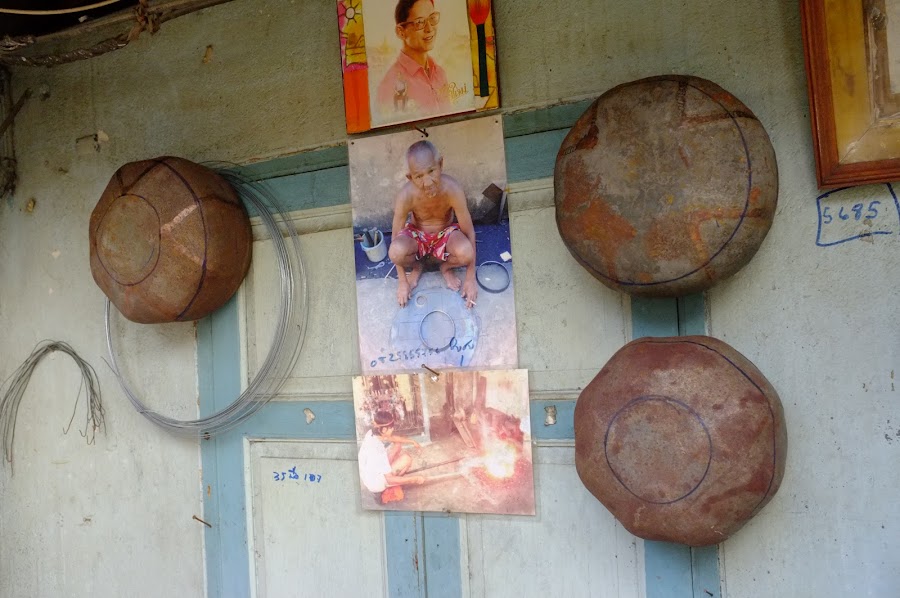
Me enseñó sus fotos de joven
Es impresionante ver a la persona fotografiada muchos años antes y ser consciente de que lleva haciendo lo mismo, día tras día, en el mismo sitio, durante toda su vida.
Por otro lado, esta especie de cestos están listos para soldarles los pétalos.
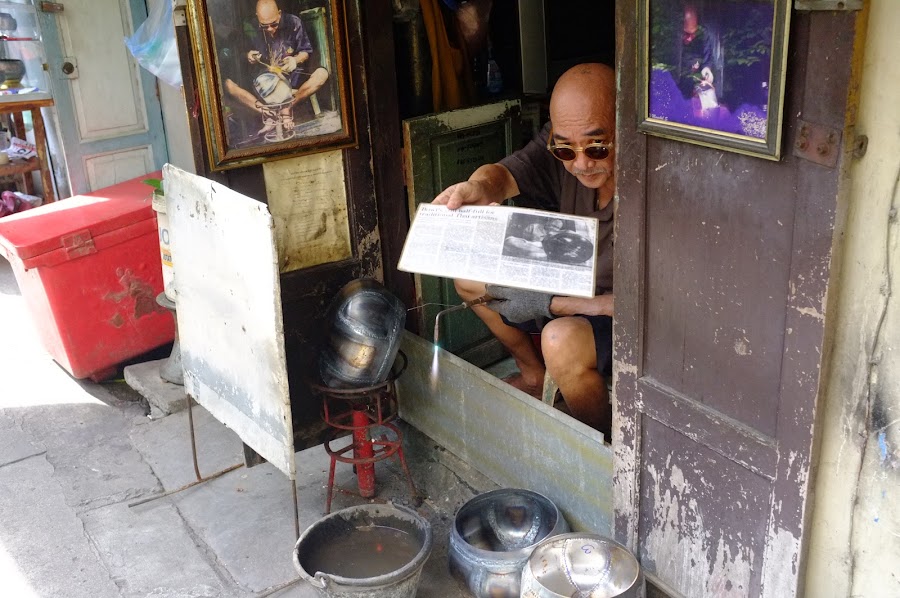
Al darse cuenta de mi presencia, dejó de soldar para tenderme un recorte de prensa extranjera plastificado, que relata la historia de esta pequeña comunidad.
Por último, esta señora refina la forma a martillazos, hasta que queda suave y uniforme. Tras esto, se hornean para darles más consistencia y ese color oscuro, como muestra el resultado final!
Dos potenciales compradores de camino a la calle.
Sometimes we go out - when we do it's hands down Levels, sometimes we stay in da hood. One of the best things about living in Ari is how of a lively area turns out to be - plenty of cafés, restaurants, bars with live music, small hipster gigs, massage, nails and tiny cute little shops - without the sensorial overload of traffic, hustlers and tourists that await in Sukhumvit. Just a very nice feeling to be able to reach places like Frank thorugh an uncompromising 2 min walk - let's see what the night has to offer.
Frank Mansion [WEB]
Address: Frank Mansion, 3-4/F, Ari One, Ari Soi 1, Bangkok, Thailand
Phone: 02-048-3225
Website: Frank Mansion
Opening hours: Mon-Sat 6pm-1am
I have passed by Dice!s door a gazillion times on the way to my beloved nail salon (Happy hours) few meters further down Ari soi 2. Judging by the entrance and claims about coffee / coworking, it stroke me as a hipster barista where entrepreneurs in rounded Oliver Peoples dropped by and debated business ideas over creamy cappuccino.
Once again, Jorge proved me wrong.
Dice! has a lot more to offer than coffee, in fact it is a whole building of amazing opportunities to work, play and chill at the terrace, where hipster parties are arranged on Saturday evenings. It felt like time travel to my beloved Stockholm, specially that day when Fer and me ended up in a VICE Magazine party thanks to some tickets I grabbed in the air, while being thrown from a mysterious van touring my hood, Södermalm. People wearing vintage, home-made projections, plastic cups and a cool crowd. We were too hangover to drink, but we def enjoyed the time and the chat.
Quite a lovely plan to wrap up a rainy Saturday, hanging with the locals.
If you give me 1 day in Tokyo, I'll take you to Shibuya. If you give me 1 hour in Tokyo, I'll take you to Shibuya. If you give me 1 min in Tokyo... It'll be Shibuya.
Tokyo is not a monumental city in the sense of Rome or Paris, where there are clear sights that one must see surrounded by charming streets and little corners, tucked away the crowds here and there, often by and for the locals. In Tokyo anything can happen, but you can never tell where, how or why.
Tokyo is a magic tale where all the people you cross by, play a character.
Baan Khrua
Al salir de la casa de Jim Thompson decidí continuar caminando a lo largo del canal por el que había llegado allí, desde Ratchatewi BTS. Supongo que el tránsito de los barcos me llamó la atención, en contraste con las casas tradicionales cada una con embarcadero y barco propio, en cuyos porches pasaban varias familias la lluviosa sobremesa. Todo tenía un regustillo tradicional, pero en ese momento no llegaba a ser consciente de hasta qué punto.
En el mapa se ve un poco raro, la mayor parte del tiempo caminé a lo largo del canal.











 Tras esto, se hornean para darles más consistencia y ese color oscuro, como muestra el resultado final!


