8.8.14

Osaka Aquarium 「海遊館 」

osaka aquarium kaiyukan

For those of you who are fascinated by marine species, Osaka Aquarium is definitely a must. One of the biggest aquariums on Earth, features manta rays and even a whale shark! Which is more of a ray than a shark, as it has no jaws and lives on plankton. The more I dive, the less I like artificial environments for the large pelagic species. Still, it is good to bring children and educate them on sharks NOT being the assassin they appear to be in movies. Seriously, if you scare of your kid with silly stories, he will end up eating shark fin soup :_( Anyway, a nice place to spend a couple of hours in a chilly March afternoon.

Para los nerds de las especies marinas, el acuario de Osaka es visita obligada. Uno de los más grandes del mundo, contiene en su tanque principal especies tan fascinantes y complejas de vet buceando como el tiburón ballena, el tiburón martillo, varios tipos de rayas (stinger ray, eagle ray) y algún tiburón más pequeño (shark reef, both grey & blacktip) que animan la escena. Una buena forma de invertir una fría tarde de Marzo :)

osaka aquarium kaiyukan
Whale Shark (about 8m - small one)
osaka aquarium kaiyukan
Green Sea Turtle, just like the ones we saw in Hawaii :)
osaka aquarium kaiyukan
King crab - alive this time.
osaka aquarium kaiyukan
Lovers on the rock
osaka aquarium kaiyukan
Jellyfish
osaka aquarium kaiyukan
Rays in a shallow pool, so that people can pet them.
osaka aquarium kaiyukan
Colorful frogs & crabs

osaka aquarium kaiyukan
Japanese joking - moon fish used to be one of the biggest attractions, till he died :(
View Post

6.8.14

Osaka Streets「大阪」: Southern District「南」

Osaka streets

If you ask a Japanese about the streets in Osaka, they probably will refer to the running Glico「グリーコ」guy.  This is it. A sign on the wall, we all feel like copying. Why is this so relevant?

Glico - shortening of glycogen - is a major confectionery manufacturer in Asia - really, how many of you never heard or tried POCKY 「ポッキー」? - called Ezaki Glico. A company from Osaka.
Candy gives energy, which is stored as glycogen, hence the name.

But how a running fella comes in the picture? Their first candy was known as Glico-Caramel and contained 15.4kcal, which is enough energy to run exactly 300 meters (provided you are 165cm, 55kg burning 8.21 kcal running 160 metres in 1min). Hence, the Glico 300 meter running man trademark.

It makes no sense - just as the million other things of Japan, that make out of it such an amazing land.

Anyway. After paying a visit to the north side of town at the Sky Building, it is time to go down south and explore the area around Namba station.

Osaka streets
Osaka streets
Osaka streets
Something weird on that street light?

Amerikamura
Aka Amemura, this shopping district is considered Osaka's counterpart to Harajuku. Lots of teenagers, some fun kids to watch and inexpensive souvenirs for our friends back home. Buzzling with cafés and thrift shops, makes up for a good starting point.

Osaka streets
Osaka streets
Osaka streets
Cat café & japanese streets, with all the cables floating. Same in Tokyo. 3 years there and still wondering, what is the real reason for this...

Osaka streets

Besides the Glico man pictured above, the river is packed with gorgeous buildings and opens up for a walk away from the crowd. Or something else. I would guess that these are indeed Love Hotels - you know, those hotels where one can pay for a 2-hour or 3-hour rest but not many guests stay through the week

Osaka streets
Shinsaibashi Shopping Arcade
This is your traditional Japanese shopping area, along with covered street to make it comfortable through the rainy and the typhoon seasons (10-21). 600m of a crowded  mix of designers, Asian high-street, matsumoto kiyoshis and even some pet store. Another souvenir opp.

Osaka streets
Osaka streets
Osaka streets
Osaka streets
Osaka streets
Dotonbori
This is probably the most special thing of Osaka, as already explained. They are known for their love of food. Huge signs and 24x7 open restaurants. Giant sushi, crab, octopus, gyozas, fugu. All of them MECHANIZED and moving, as you walk past.  At night it is lit by hundreds of neon lights, so you can get a different shot on the Glico man.

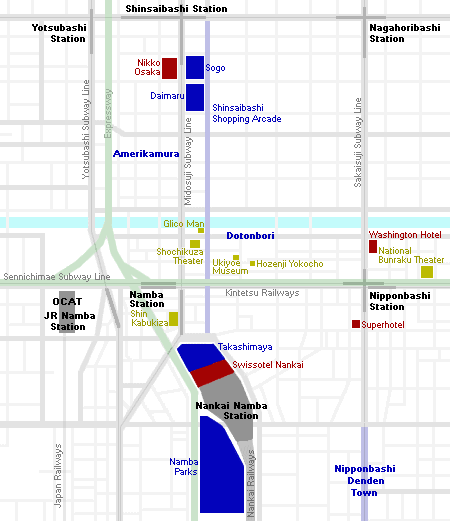
Here's a map for the mini walk-tour. With lunch and not much shopping, you can cover it in 2h.

何で姉!! *「なんであね」or  nande ane is a typical Osaka idiom. You will hear it a lot.
Literally means "why, sister?" but used to express many things (anger, surprise), when you master Kansai dialect


View Post

5.8.14

Osaka「大阪」: Umeda Sky Building「梅田スカイビル」

umeda sky building osaka

Umeda Sky Building「梅田スカイビル」 may not be the highest building in Osaka at 173m height (40 floors), but is certainly one of the city's most recognizable marks. Located at the Northern part of the city, it was originally envisioned as a conceived as a "City of Air", which would have four interconnected and a floating platform on top. Practical considerations brought it down to two, but hey, it's still worth a walk around to judge whether it feels like the floating city it was meant to be, at least in Hiroshi Hara's mind.


El Umeda Sky Building「梅田スカイビル」 mide 173m de altura y no es el más alto de Osaka, pero sí uno de los más interesantes. Son dos torres iguales, de 40 pisos, conectadas en su parte más alta con puentes y una escalera móvil, que cruza el ancho atrio central. Corona el edificio una plataforma de 54 por 54 metros, perforada en su centro por un anillo acristalado

Hiroshi Hara - su arquitecto, quiso dar al edificio la apariencia de una ciudad flotante, para lo cual ideó el uso de cristales especiales en la parte superior del mismo, los cuales reflejan el cielo como paisaje exterior, contrastando con la cerámica opaca de su parte inferior.

umeda sky building osaka
Interior of the escalator-tunnel that leads to the so-called "city of air"
View Post

3.8.14

Kansai

ciervo blanco de nara

Before starting a new series about the musts of Osaka and Kobe, I'd like to put things a bit in perspective.

As presented in an earlier post Japan consists of thousands of islands, being Honshu 「本州」the biggest among all of them.

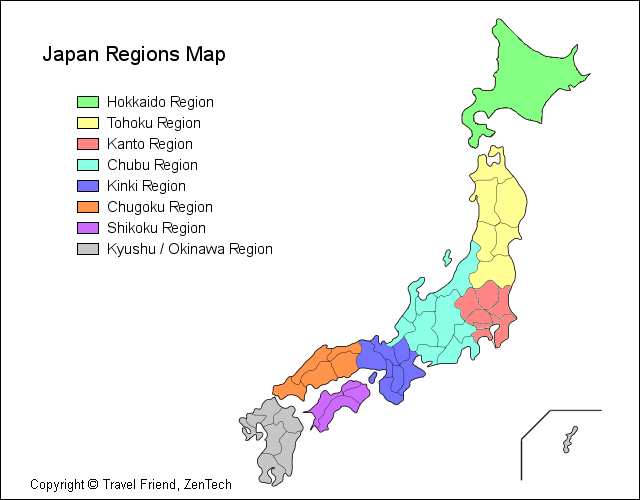
There are 8 main regions in Japan, 5 of which are located in Honshu, being Kansai「関西」(Kinki in the map below) and Kanto「関東」, the biggest and most prominent among all of them; where you are likely to spend most of your days in Japan.


West and East, haven rivaled for a long long time.

Kanto region symbolizes standardization throughout Japan and opening up to the World, during Meiji Restoration, first time in history for the Empress to wear Western-style clothing as an example.

Kansai displays many more idiosyncrasies and represents the focus of counterculture in Japan:
- Kyoto, the Culture
- Osaka, the Merchants
- Nara, the History
- Kobe, the Cosmopolitan Harbour

This East-West rivalry has deep historical roots, particularly from the Edo period, where the power shifted from Kyoto「京都」to Edo「江戸」(it would not be renamed to Tokyo「東京」until the Meiji emperor physically moved his residence there in 1868).

For those of you curious about kanji:
-「京」means "place where the Imperial Palace is"
-「都」means "metropolis"
-「東」means "east"

Consequently, Kyoto literally means "metropolis where the Imperial Palace is (i.e. Capital)" and Tokyo means "Eastern Capital". It is an Asian tradition to include the word capital 「京」 in the name of the capital city e.g. anyone heard of Beijing? Northern Capital「北京」; Nanjing? Southern Capital「南京」. By the way, all Japanese Kanji were imported from China - they mean the same, but are read differently.


What you need to remember is that, Tokyo may be the heart today, but Kansai is undeniably the place where it all started.

Nara, the most eastern point on the Silk Road, became the site of Japan's first permanent capital. This period (AD 710–784) kicked of the Buddhism to Japan and the construction of Tōdai-ji in 745.
During Heian period, the capital moved to Kyoto (then called Heian-kyō「平安京」) where it would remain for 1000 years until the Meiji Restoration.
During this golden age, the Kansai region gave birth to traditional Japanese culture:
- Noh and Kabuki, Japan's traditional dramatic forms both saw their birth and evolution in Kyoto.
- Bunraku, Japanese puppet theater, is native to Osaka.
- Geisha originated in Gyon 「祇園」a neighborhood of Kyoto.
- Along with so many temples and monasteries that you cannot even count.

Osaka, as supported by the saying "Kyotoites are ruined by overspending on clothing, Osakans are ruined by overspending on food" 「京の着倒れ、大阪の食い倒れ」is famous for its food. Osaka was a merchant city, with less than 1% of Samurai, in sharp contrast with Edo「江戸」which was, the seat of power for the Tokugawa shogunate 「江戸幕府」.

Kobe, besides excellent at Wagyu Beef, became an important hub for trade with China and other countries, with many foreigners residing until WWII started (ironically, in the plane back home, I watched a movie called "A boy called H" which captured the scene pretty well and how hard it is for long-term residents to leave Japan :_()

Kansai held power for thousands of years, but lacked damage from either war or natural disasters and has now more UNESCO listed sites than any other Region of Japan. Together with the great food and contrasting atmosphere (compared to Tokyo) is worth dropping by for a couple of days.
View Post

1.8.14

Osaka 「大阪」

Osaka streets

Right before leaving Japan, we did so many things we have not been able to do before, that those weeks were a hectic roller coaster of events. Now there's time and many who are planning some weeks in the Far East. Seems like a good idea to revisit all photographic material and give you guys some local tips, as we were guided and shown around by the real locals or Horiguchi-san family!!


Stay tuned...
View Post

23.3.14

Osaka「大阪」

puma store osaka

Los que nos seguís en instagram sabéis que llevamos 3 findes sin parar. De Tsukiji al Buddha de Chiba, pasando por los colores de Osaka y la revelación Victoriana de Kobe. En Tokyo nos vamos a dormir, pero esperamos ponernos al día durante esta semana: stay tuned!

疲れたなぁ。おやすみなさい(=^*^=)
View Post
© dontplayahate. All rights reserved.
DONTPLAYAHATE