26.8.18

El rey de la seda

Jim Thompson the king of thai silk
Ayer visité la casa de Jim Thompson, cuya vida es una de las más fascinantes del Sudeste Asiático. Quizás por ser una persona con empeño, visión y positividad me resulte un perfil tan inspirador al nivel del inimitable Rauschenberg. En un nivel abstracto mi propósito es similar: Divulgar, entretener y crear entusiasmo en Occidente, acerca de las maravillas que esconde Asia.
View Post

25.7.17

Seoul - Sik Mool

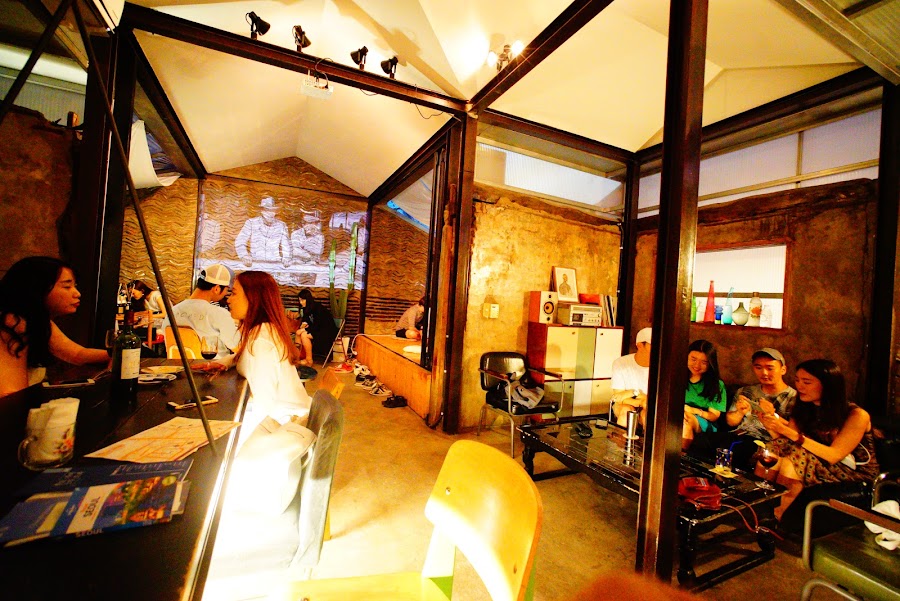
Sik Mool, cool bar in Ikseong-dong district in Seoul
Sentados en  la mesa compartida, con buenas vistas del manga alternativo que proyectan constantemente... Atentos a los 4 que comparten sofá, eso sí que es amistad.

Nos costó encontrar Sik Mool, pero el esfuerzo mereció la pena. A los dos nos encantó este sitio que combina tradición y vanguardia, con un toque artsy. Aunque sea una gota en el mar de garitos en Ikseong-dong, sus paredes capturan la esencia que se respira en este barrio donde todo y todos son tan effortlessly cool.

Sik Mool realmente son cuatro hanok fusionados dando lugar a (mi arquitectura favorita) un área abierta, con muros y suelos recubiertos de hormigón, propaganda soviética, cactus, jabón artesano, IPA y vino a precio de saldo - por 20€ en Asia no compra una botella todos los días. Si vas solo, no pasa nada, pues las copas son más que generosas.

El menú es bastante simple, con picoteo español - jamón, queso, algunas olivas - para entretener la gana y poco más. Mini-punto negativo por tener el valor de sacar las raciones sin pan de acompañamiento. Esto del pan es algo que me da mucho coraje. Aunque pensándolo bien, he visto cosas peores, como Boqueria en Estocolmo, donde te cobran a 3€ la ración de pan y son capaces de sacar 3 lonchas en el cestillo para una mesa de 4... VALOR!

Altamente recomendado si visitáis la ciudad, especialmente para los que pasan un período más largo. Porque cuando ése "pero quién me mandaría venir aquí..." un vinito o una caña en un sitio guay, ayuda mucho a pasar el trago! Os dejo un mapa y una foto de la entrada, espero que junto al mapa en nuestro post de Ikseong-dong os sea fácil encontrarlo!!

Sik Mool is a highly advisable spot in Seoul provided you like concrete, hanok, drinks and all things cool. Located in the heart of the often forgotten area of Ikseong-dong, the place offers cocktails, coffee, wine (at very reasonable prices), IPA beer and house-made pizza. This is a place to find a young artsy crowd in an effortlessly cool environment, pretty much like the rest of the cool businesses around Ikseong-dong hanok district. Don't miss it!! It won't disappoint.

SIK MOOL 식물
46-1 Donhwamun-ro 11da-gil, Ikseon-dong, Jongno-gu, Seoul, South Korea
11AM - Midnight


View Post

24.7.17

Seoul - Hipster alleys of Ikseong-dong

ikseon-dong neon lights
Tras pasar el día explorando los palacios de Gwanghwamun, centro neurálgico del país durante los 600 años que duró el período Joseon (desde 1395 hasta la ocupación japonesa en 1910); caminando entre las viviendas tradicionales hanok de Bukchon; presenciando una manifestación pro-USA / pro-Park; volviendo a visitar a los impresionantes buddhas de Jogyesa y explorando las tiendecitas de Insadong... Decidimos que sería una buena idea ir a tomar algo, algo hay que hacer en Sábado. Habíamos merendado-comido un kakigori koreano llamado patbingsu a las 6, después de todo el día caminando estábamos bastante cansados y teníamos poca hambre. Así que seguimos el camino hacia el prometedor bar descrito por Lonely Planet, hipster, cubierto de arte moderno y decorado al estilo industrial, en el interior de 4 hanok remodelados.
View Post

23.7.17

Seoul - Gangnam Nail Art

nail salon in Gangnam, Seoul
Qué tal la semana? Por aquí bastante movidita. Enrique ha pasado dos noches fuera, trabajando turnos nocturnos en Daegu. Mientras tanto, yo me he quedado dos días trabajando desde nuestro room. Esto me ahorra 3h de bus y me permite tener un horario más compatible con el Europeo, al no tener que cortar a las 18 porque se va el shuttle bus de la oficina. Con estas 3h extra, he conseguido ir al nail salon, que ya me tocaba. Hoy va de belleza el post - si te interesan historias como esta, haz like en nuestra página de Facebook para no perderte nada!

Background
No soy de llevar mucho maquillaje, ni tatuajes-micropigmentaciones, ni pestañas falsas, ni de arreglarme el pelo excesivamente, pero hay una dos cosas en las que pongo atención: cejas y uñas.

Desde que volví a España, soy fiel al Benefit Brow Bar de Marbella. En 2014 no había en el centro de Málaga (y ahora que hay tienen como dos meses de lista de espera :O) así que empecé a ir al del centro comercial La Cañada, donde también encontré peluquero (Esteban en Monisú, es el #1), TOPSHOP y UTERQÜE. Así que de vez en cuando hago una excursión de pampering. No había ido a ningún otro sitio hasta este Enero, cuando me encontré de rebote en Bangkok y decidí arriesgarme con el Anastasia Brow Bar - en Bangkok hay varios, si vais de vacaciones y os apetece probar llamad de antemano para asegurar la hora - que también os recomiendo!

Mientras que mis cejas mejoraron al volver a España, mis uñas han perdido mucho arte al dejar Japón, donde como ya os he comentado en posts anteriores:
nail salon in Gangnam, Seoul
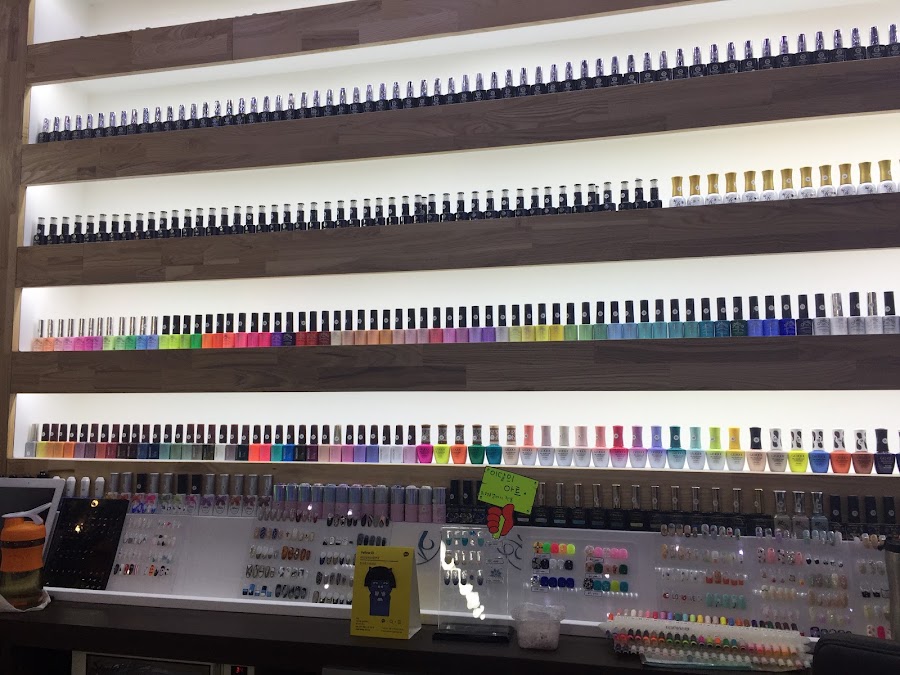
Aquí una muestra de sus herramientas de trabajo, con el pincel fino hacen los dibujos que luego arreglan con una punta afilada de goma, hasta que quedan perfectos antes de secar con el LED.

My Korean Nail Art Experience
Así que un poco intencionadamente, un poco circunstancialmente, dejé pasar el retoque de uñas ...Pero como siempre en Asia profunda, nada es tan fácil como imaginarías ya que las cosas más sencillas se convierten en un problema cuando no puedes leer ni escribir:
  1. Encontrar un salón de uñas, en un país donde que GOOGLE te muestra 1/10 de los resultados que saca NAVER; donde el GPS no es muy fiable porque las calles son estrechas; donde se construye en alturas, con lo que no vale encontrar el punto en el mapa, sino que tienes que identificar por dónde entrar y en qué piso está leyendo el nombre en Coreano. Mi habilidad de leer Japonés combinada con lo que he aprendido de Hangeul en el bus, me salvó - los demás podéis advinar en qué piso era?? El 3!
  2. nail salon in Gangnam, Seoul
  3. Hacer una reserva, en un país donde ni los empleados de tu empresa hablan inglés. La única opción - hasta que dominas el idioma lo suficiente como para poder negociar horarios y tratamiento sin gesticular - es ir allí personalmente, aunque implique gesticular y una conversación rota del estilo (How long will it take? Two o'clock!) que termina contigo enseñando una tarjeta de crédito para confirmar que es aceptada como forma de pago.
  4. Negociar el diseño y explicar lo que quieres. Nada más llegar, la nailist me tiende 4 paletas con mil colores y me dice que elija uno. A lo que yo le contesto, señalando los mil diseños super interesantes (suckers for nail art raise your hands now...) a su espalda, si sería posible hacer gel design (keyword: DESIGN)?

    Me contesta casi gritando con un "NO!!!!!" muy tajante... "NO TIME". Y me quedo con cara triste, pero sigo escaneando los mil diseños pensando en que la próxima vez será, hasta que mis ojos se paran en algo que me resulta muy familiar a la última manicura que me hice antes de dejar Tokyo (incorrigible nostalgics raise your hands now...).

    Mientras tanto, con ayuda de fotos en mi móvil... Le explico lo fan que sou del nail art y lo mal que lo paso en España, donde no se lleva nada y por lo tanto, no hay casi artistas cualificadas para hacer las monerías que te hacen en este lado del mundo. Cuando vuelve a preguntarme por el color, señalo el diseño con cara de pena y le pregunto si sería posible que me hiciera ése que es más sencillo. A lo que acepta, tras buscar la mirada aprobatoria de su supervisora (YASSSS!!!). Cuando pasamos a la pedicura me vine arriba y le pedí dos uñitas plagadas de pedruscos porque soy una urraca incurable. Salí de allí tres horas más tarde, pero super contenta. De allí me fui a trabajar lo que quedaba de mi jornada desde nuestra mesa frente a la ventana sin vistas.
nail salon in Gangnam, Seoul
Victoria!! Un gran momento cuando cogió la paleta con diseños y la colocó sobre los colores base..


Quick tips for manicure, pedicure and nail art in Seoul
...now a small summary and quick tips based on my experience as a newbie, specially targetted to those who don't have much time and don't speak Korean:
  1. Google maps won't help as much as NAVER / KAKAO MAPS. If your Korean isn't there yet, try to "search near me" the following 네일아트 (nail art) or 젤네일 (gel nail)
  2. Find the place and go there physically to make a reservation.  Often these spots are in height, make sure you have the name of the place so you can cross-check against the building information.
  3. Use as few words as possible when you talk (both Korean and Japanese have different gramatical order than western languages, so more words = more confusion, this is a VERY COMMON mistake done by natives actually) and focus on the key words: gel nail, one-color, french, deep french, design, stone, gradation, hand, foot, care (if you want scrubbing etc with your pedi, cuticle care is included by default), cash, card.
  4. Price can go up quickly. As you can see in the example price list below, one-color costs half of french, former gel removal is also charged, design nails are priced per unit and added on-top of your prime choice, 10% TAX is typically not included in pricelist. In Japan, when you don't pick a default design (some examples here), price also depends on the complexity of the design e.g. the number of stones placed).
  5. Mitigation for price uncertainty, in case none of the designs in the store suits your taste, is to prepare the nail visit by finding a design you like, bring the picture with you, show and ask how much. 
  6. Make sure to check NAVER / KAKAO / INSTAGRAM for discounts. I am sure there are plenty of offers and vouchers out there, it's just my Korean which is not yet there.
Lulueyelash [WEB]
This is the place I tried. Conveniently located close to the Gangnam Subway station i.e. where we stay, they have a very clean and comfortable space with a rather cool nail art offering. They also do micropigmentation and eyelash extension.


nail salon in Gangnam, Seoul

Nail art fans in Korea, learn the following keywords:
- gel = 젤
- nail = 네일
- art = 아트
- design = 디자인
- pedi = 패디

Here's the price list for nail art. Below you can find a translation, keeping the names in Korean side-to-side so you can use as reference to read other price charts. I am certain there must be cheaper spots, but this is to provide a ballpark figure.

GEL NAIL 젤네일
Basic Gel 기본 젤 33,000
French 프렌치 44,000
Variation French 변형 프렌치 55,000
Gradient 그라데이션 55,000
Glitter Base 글리터 기본 66,000
Glitter French 글리터 프렌치 77,000
Glitter Grace 글리터 그라 88,000
Clear maintenance 클리어 보수 11,000
Design 1 nail 디자인 보수 3,300
Gel removal 1 nail (fits) 젤 제거 (쏙) 1,000
Out-of-the-way removal gel 1 nail 타샵 젤 제거 1,000

GEL PEDI 젤패디
Basic Gel 기본 젤 44,000
French 프렌치 44,000
Variation French 변형프렌치 66,000
Gradation 글리터기본 66,000
Glitter Base 글리터기본 77,000
Glitter French 글리터 프렌치 77,000
Glitter Grace 글리터 그라 99,000
Nutrition Care 영양케어 11,000
Color Care 컬러케어 16,500
Add nutrients + quick spray 영양제+퀵스프레이 추가 5,500
Scrub + massage added 스크럽+마사지 추가 11,000
nail salon in Gangnam, Seoul

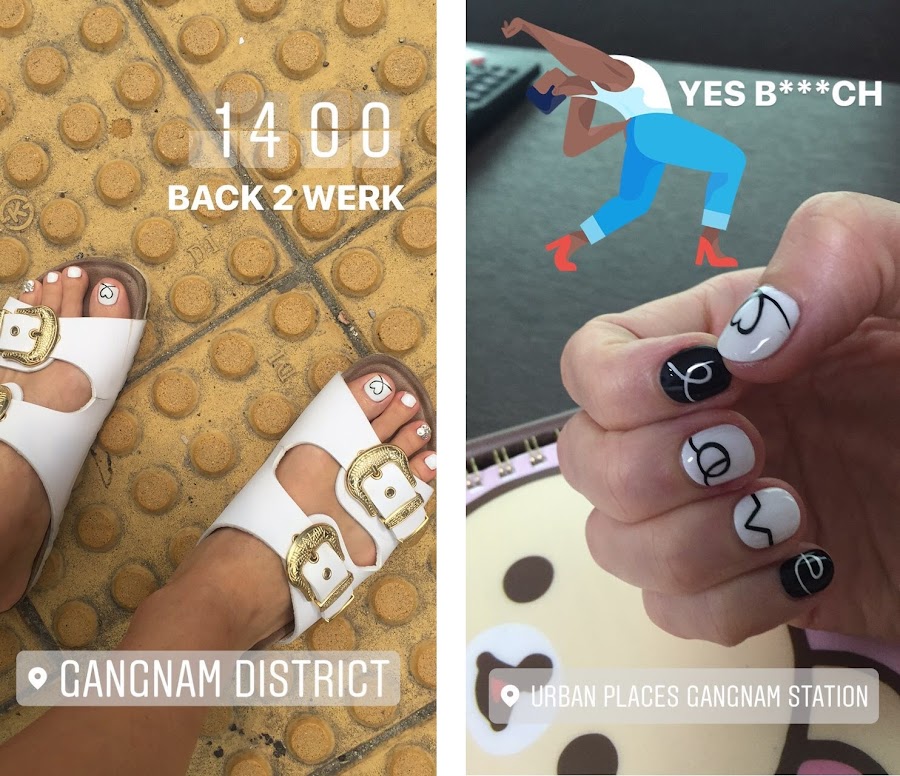
For a total of 10 nails with design which you can see in the pictures below (follow us in IG for more daily life!), the rest in one color, I paid 170500 (about 130€) which is a bit too much. I think my hands were classified as glitter grace and my feet as glitter base, on top of which a 10% tax was added. They caught me as newbie in Korea thinking it would be cheaper than in Japan, but it won't happen again... Will follow (5) from now on, check the designs in advance - there are plenty as you can see!
nail salon in Gangnam, Seoul
View Post

15.6.17

Miami - The story behind our 640i ride

640i, Miami

Those of you who follow us on Instagram may remember our BMW 640i ride along the bridge between South Beach and Downtown.

To get things straight, we did not book such car - which is only made available by specific reservation, for the record - just happened to drop by SIXT in an extremely busy season, meaning the car we had actually booked was not available with the next best option being paying a bit extra per day (and a YUGE deposit) to get this convertible dream instead.

Things turned out to be fine, we did not damage the precious ride and got a feeling of the Miami vice in our hair. In the end, it might be worth the investment - because if you're gonna drive it once, where could be better than Miami Bay?


View Post

19.4.17

Itoya: Ultimate Japanese stationery shopping

Itoya

Guess I've been a sucker for stationery, paper and ink my whole life. From kindergarden cardboard art through art-school grade calculus notes featuring highlighter and metallic ink, you could see my taste for harmonious colors and graphic art breathing through my technical education. Also worth noting is my limited memory, as Chris calls it "the cheap RAM" - where pictures stick far longer than text.

Then, I moved to Japan. The country where paper folding art, origami「折り紙」 has been practiced since the Edo Period (1603-1867). The country where my beloved gel pens were invented by Sakura Color in 1984 - the year I was born. The country where erasers are art and envelopes a core aspect of the main events in life (birth, wedding, death).

Itoya store in Ginza has a 113 year history, is the mecca of stationery. Now spreads accross 2 buildings (G.Itoya in the main street of Ginza, with more refined things which you can see in this post; K.Itoya right behind, with common items like notebooks in B4 sizing - which I love). The store has it all, from pens through agendas, greeting cards or speciality paper. Just like you cannot leave Scandinavia without browsing through a furniture store, you cannot leave Japan without browsing through Itoya.

Itoya Ginza [floor plan] open 10AM-8PM (Sundays until 7PM)
Ginza Station (Marunouchi, Hibiya, Ginza lines)


View Post

24.2.17

Miami - Wynwood streets

Colorful murals around Wynwood streets, Miami
LOVE is the answer

Once you are done with the walled "official" gallery, make sure to book some time and explore the area randomly - which is the best and only approach that works. A lovely middle-aged gay couple rom New York stopped us to inquire where to go for more walls, to which we answered to be checking out with no plan :) this is part of the beauty of travel, getting lost is a great way to find yourself. Well not too lost... That's panic mode, yes I trust you get the point.
View Post

22.2.17

Miami - Walt Grace Vintage

Walt Grace, vintage cars and guitars, Wynwood, Miami

Artsy neighborhoods often hide pearls like Walt Grace Vintage. Store concepts that you have never seen and probably will never see again. This is why I love them so much...

Walt Grace Vintage is a unique gallery focuses exclusively on the finest investment grade automobiles and vintage guitars. Over 25 years buying, selling and collecting, they procure the finest examples of both for their collection. Lovely place where both discerning buyers and casual observers can experience the beauty and artistry, common to vintage cars and vintage guitars.

The store is located right after you exit Wynwood Walls, make sure to drop by.

This post goes to our friend Mario, huge fan of cars and guitars, as well as the one who introduced me to Enrique more than 10 years ago. Mario, we hope you can visit this place one day, we could only think of you while exploring it - but make sure to come after you reach some kind of C-Level position somewhere, to actually be able to afford something... Otherwise it will be extremely painful, so we rather encourage you to avoid it.
View Post

21.2.17

Miami - Wynwood Walls

Wynwood Walls, Miami

If you've been with us long enough, you probably know I am a sucker for modern art.

Turns out the phenomena of great art arising amid rusted warehouses is a Global Phenomena, simply because artists have a tendency to be broke but love to gather with their-likes in areas where it's somewhat affordable to live and rent a working space. We have visited some of these spaces, remember:
- 798 in Beijing
- Meatpacking in New York
- Södermalm in Stockholm
- Maboneng in Johannesburg
- Kloof & Long Street in Cape Town
- Kampong Glam in Singapore
- Daikanyama & Cat Street in Tokyo - as well as other areas further out, like Koenji
- Margareten in Vienna, Malasaña in Madrid...

Wynwood is a district in Miami where street art beats Berlin. Sorry Banksy, but seriously the size and condition of these murals are something new to me. We started exploring the area with the main hub, where a collection of selected walls is showcased together with a small museum where one can see the work of the same artists in alternative media. Very cool experience to go from mural into wall painting or sculpture.

Wynwood Walls [WEB] opens 12-20, Wed-Sat - for more Miami goodness, checkout our Miami Guide!!! We went there by rental car, but Uber is also a good choice if you won't move much further.

View Post

19.2.17

Miami - Bass museum of art

Bass museum of art Miami

Bass Museum of Art was unfortunately under renovation when we visited in December 2016, but guy's don't miss the big opening in Spring 2017, when it will re-open after renovation, as the largest art museum education facility in Miami-Dade. What we managed to visit is the temporary exhibition at the Miami Beach Regional Library space, in conjunction with the outdoor exhibits laid gracefully in the park by the entrance. Out of them all, the colossal colorful stack by Ugo Rondinone stole my heart.

Ugo Rondinone (born 1964) is a Swiss-born mixed-media artist living in New York. His work frequently employs the experiential qualities of the everyday, often reflecting on the boundaries between fiction and reality. The cairn in Miami is small sample of his work, with the masterpiece Seven Magic Mountains, currently on display along Interstate 15 just south of Las Vegas (May 2016, May 2018). This installation of seven neon stone cairns painted in artificially bright yellows, purples and other colors is constructed from car-size stone cut from a Nevada quarry and stacked 10m high.

A cairn is a man-made pile or stack of stones. The word cairn comes from the Scottish Gaelic: Càrn (plural cairn) which translates to "heap, pile up, accumulate" or more literally "heap of stones". Cairns historically have been used for a broad variety of purposes, from prehistoric times through present day. Dating back to prehistory, examples of cairns can be found having been used for many functions including those built as burial monuments, defense and hunting structures; ceremonial assemblies; astronomical formations and location markers (specifically for buried items such as caches of food or objects) as well as trail markers, among others. In modern times, cairns are most frequently used as trail markers throughout many parts of the world, in diverse climates and terrains. They vary in size and complexity, from loose conical rock piles to delicately balanced sculptures and elaborate feats of megalithic engineering. Occasionally, cairns are also decorated, either for increased visibility or religious reasons.

In addition to Rondinone's work, the park is full of interesting pieces - being the lady of Avocado our second favourite! 

For other cool spots, recommendations & maps - check out our Miami guide post!

View Post

6.2.17

Miami - Art Deco

Art deco walk around Miami

Affectionately known as the "Art Deco" District, the Miami Beach Archirectural District embodies the design continuum of the city from its early development period in the 1910s to the construction boom following World War II.

South Beach was reborn as an ArtDeco haven after a hurricane in 1926 destroyed much of the city.  A decade of intense building later, Miami became home of the world's largest collection of Art deco architecture - 960 spectacular buildings in total.

The district was listed on the National register of Historic Places in 1979 largely through the efforts of Barbara Baer Capitman, founder of the Miami Design Preservation League. At the time, it was the youngest district on the National register as many of the buildings had not yet reached 50 years of age.

View Post

29.8.16

Beijing - 798 Art Zone「798艺术区」

798 Art Zone, Beijing

When visiting Beijing during Spring, my friend Chris who was born and raised there, advised to check out 798 Art Zone. Also known as Dashanzi Art District, it was walking distance from Crowne Plaza Lido (my home for the week) and visible and citymaps2go - a must when you don't have data, don't speak Chinese and plan to explore a city in a country where Google is not exactly welcome. This communist factory environment (industrial interiors but for real) which was built 50 years ago, turned into an avant garde neighborhood is the ultimate plan for a weekend morning exploring an unexpected side of Beijing.

This post is a bit of a photobomb, but it captures how I felt exploring the area. Amazed by the creativity and the size of this industrial dream. There are 3 main areas I found, took about 3 hours to explore including some souvenir shopping - really cheap and cool stuff:
  1. Public Service Center for Beijing 798 Art Zone (southernmost, featuring a Tibetan Art center)
  2. 798 Art District (street installations, shops, galleries and Bauhaus-inspired arcs and windows)
  3. 751D Park (from Ace Cafe, the area from the station through the buildings with many pipes)


Background

The Dashanzi factory complex began as an extension of the "Socialist Unification Plan" of military-industrial cooperation between the Soviet Union and the People's Republic of China. By 1951, 156 "joint factory" projects had been realized under that agreement, part of the Chinese government's first Five-Year Plan. However the People's Liberation Army still needed modern electronic components, which were produced in only two of the joint factories. Since the Russians were unwilling to undertake an additional project, they suggested the Chinese to turn to East Germany, a big producer of electronics at the time. The project was green-lighted in early 1952 and a Chinese preparatory group was sent to East Berlin to prepare design plans. This project was the largest by East Germany in China, was green-lighted in 1952. Officially named Joint Factory 718, it followed the Chinese government's method of naming military factories starting with the number 7.

The architecture was influenced by the Germans, who chose a functional Bauhaus-influenced design. The plans, where form follows function, called for large indoor spaces designed to let the maximum amount of natural light into the workplace. Arch-supported sections of the ceiling would curve upwards then fall diagonally along the high slanted banks or windows; this pattern would be repeated several times in the larger rooms, giving the roof its characteristic sawtooth-like appearance. Despite Beijing's northern location, all windows face north as the light from that direction would cast fewer shadows.
798 Art Zone, Beijing

The chosen location was a 640,000 square metre area in Dashanzi, then a low-lying patch of farmland northeast of Beijing. The complex was to occupy 500,000 square metres, more than half dedicated to living quarters. Fully funded by the Chinese, the initial budget was 22MUSD, which is a lot of money today, but even more so in the 1950s.

The equipment was transported directly through the Soviet Union via the Trans-Siberian railway, and a 15 km track of railroad from Beijing Railway Station to Dongjiao Station, purpose built to service the Joint Factory 718 began production in 1957, amid a grandiose opening ceremony and display of Communist brotherhood between China and East Germany, attended by high officials of both countries. It would be fully functional until the early 1990s, when deprived of goverment support like many state-owned enterprise, it simply declined until it became obsolete. The remains of the management were reconstituted as a real-estate operation called "Seven-Star Huadian Science and Technology Group", charged with overseeing the industrial park and finding tenants for the abandoned buildings.

The Dashanzi factory complex was vacated when most of Beijing's contemporary artist community was looking for a new home. Avant-garde art being frowned upon by the government, the community had traditionally existed on the fringes of the city. In 1995, Beijing's Central Academy of Fine Arts (CAFA), looking for cheap, ample workshop space away from downtown, set up in the now defunct Factory 706. Through word-of-mouth, artists and designers started trickling in, attracted to the vast cathedral-like spaces. Despite the lack of any conscious aesthetic in the Bauhaus-inspired style, which grounded architectural beauty in practical, industrial function, the swooping arcs and soaring chimneys had an uplifting effect on modern eyes, a sort of post-industrial chic. At the artists' requests, workers renovating the spaces preserved the prominent Maoist slogans on the arches, adding a touch of ironic "Mao kitsch" to the place.

View Post

19.5.16

Cape Town - Kloof and Long street

Cape Town shopping in Kloof st and Long st
In many ways, Cape Town feels just like San Francisco. Cool city by the sea, with victorian houses, surfers and a huge art community. The only difference is that while in SF you can walk around for days, in Cape Town you need to be more careful, specially at night. Violent crime has been reduced dramatically in the recent years, but still pick pocketing is an issue. Enrique had his phone stolen twice and it would not be the case of any night they went out to come back home without incidents - always someone would have had their wallet and / or phone stolen. Beware of anyone who approaches you, specially kids that are sadly used for this purposes. That's why you see me wearing this old bag which is not large enough to fit by iPhone 6PLUS - because I left it home, together with my new watch and wedding ring. Be careful please!

Best shopping in SA (except for the weekend markets in Johannesburg) are Kloof ST and Long ST in Cape Town, our top 3 favourites were:
  1. Holmes Bros [WEB]: Local Durban brand for cool guy's clothing - yet got a bomber for me...
  2. The Ceramic Factory [WEB]: There's a Global trend on cool ceramics, at least affecting South Africa and China - in Beijing I also found many pieces on this style - all about making funny things such as robots or animal heads in minimalistic porcelain for a cool touch at home
  3. Pan African Market: Carefully selected African art. It's not cheap but amazingly curated.
View Post

17.3.16

Singapore - Artscience Museum

Singapore artscience museum

Entre todos los edificios de Singapore, esta flor de loto gigante terminó por convertirse en nuestro favorito - de hecho creo que en el fondo, entramos a ver la exposición del Large Hadron Collider, simplemente para observar el edificio desde dentro.  Una muestra más de que merece la pena ser diferente, sin tener miedo a resaltar. Ser una flor... En un mundo de rascacielos.

View Post

16.7.15

Seoul「서울시」: Dongdaemun Design Plaza「동대문 디자인플라자」

Dongdaemun Design Plaza by Zaha Hadid and Samoo

Sometimes you come back to a place to realize a huge - yet somewhat sudden - change. This was more or less my feeling the day I jumped off the train on a shopping spree mission. At the exit of the train station there is this map of buildings, featuring Doota, Migliore and other malls I've heard of. But then, what is that humongous blob that is taking over an entire block? Dongdaemun Design Plaza?

View Post

5.11.14

Batik

batik sarong

Strictly speaking, batik is just the name for the technique of printing textile using wax. The artisan draws using a pointed tool or deposits the wax with a copper stamp. Since the wax is dye resistant, it is possible for the artisan to soak the cloth in different colors and selectively dye the textile. Wax is then removed with boiling water, so he can continue dying with as many colors as desired.

Batik in Indonesia, is much more. It is the print style that represents the nation, where colors and patterns are sometimes associated with families or even the royalty - the latter are actually forbidden to wear by the rest of the population. Indonesia was occupied by Dutch from 1602, formally nationalized Dutch colony in 1800. Dutch ruled until 1942, when the Japanese expansion in the Pacific took over Indonesia. After their surrender in 1945, Indonesia declared independency. It is also possible to see traces of this occupation in some print designs including Japanese designs (like sakura blossom)

Besides National Batik Day - which actually took place during my visit, company employees are encouraged to wear Batik every Friday. So you can imagine everyone, from the CEO to the cleaning lady, covered by colorful prints. Foreign companies with premises in Indonesia also adhere to the local custom, so it is double fun, with the average Joe or the blonde Svensson, dressed in print.

various batik prints for sale in Jakarta shopping mall

Batik is traditionally sold in 2.25m length which can be used for sarong. It can be worn in 2 ways, either wrapped around the hip or made into a hat, which is called blangkon. The pattern of the cloth can be the same throughout the cloth or divided into sections, so that different parts appear when it is twisted around the body.

clothing and other accesories made with batik

It is possible to find clothes already made with Batik, but generally speaking it is not cheap, at least in the malls of Jakarta. so I wouldn't recommend to buy clothing as souvenir (unless you buy it for you or for someone who is really keen on color), otherwise it may very well end up as Halloween costume to play a 70s hippy. However, scarves, pareos, bags or pouches can be much more attractive for the western fashionista on the quest for exotic accessorizing. It is also possible to find home items, like cushions or tablecloth in Batik, which pair nicely with wooden bowls and cuttlery which is increasingly popular.

Did you like Batik? Where would you wear it or use it? Leave a comment (^_^)

View Post

15.10.14

iPhone 6 Plus : The Phablet Era

iPhone 6 plus launch Madrid store

I woke up the morning of 23rd September - our wedding anniversary - with two big surprises. A huge orchid and a spot in the pre-order queue so that I could pick up my iPhone 6 Plus the day of the launch. Having been with an iPhone 4 for the last 4 years (as it was the company device we were given in Japan and it was not possible to use the company SIM in a different device due to the way contracts are written in Japan) this was going to be a major change.

View Post

1.9.14

Stockholm: Hemma

fatbursparken lägenhet minimal betong vitt

Todavía me acuerdo de aquel día. Cuando caminando a través del parque, de camino al gourmet Japonés de Södra Station, leí de repente "Barcelona". Resulta que el Bofills Båge es un edificio emblemático en Södermalm, obra del arquitecto Español Ricardo Bofill Barcelona. Años después, se convertiría en nuestro hogar, mi Palacio Blanco. Ese entorno donde encontrar paz, amor y tranquilidad. Cada vez que vuelvo, se me caen las lágrimas. Como es normal, cuando alguien regresa a su hogar. Me siento segura, comprendida, encantada sobre el suelo de micro cemento, que a muchos les resulta frío e industrial.

En el vacío, encuentro la claridad. Que a menudo me falta, en esta sociedad de jolgorio, color y desorden sin par. Si pasáis por la ciudad, caminad un poco más allá de Medborgarplatsen, para contemplar la vida del Södermalmsbo (el que vive en Söder) que se tumba con unas birras y una caja de sushi bajo el sol, a ver la vida pasar. Aprovechar al máximo los días de verano es obligación, porque nunca se sabe... Cuando terminarán.

Si os interesa la decoración,os pongo un video de cómo era nuestro White Palace cuando todavía vivíamos allí (ahora tenemos de inquilino a un amigo tan bueno que nos deja quedarnos, cuando no está - espero que sea consciente de lo feliz que nos hizo esta oportunidad, de volver juntos, a nuestro hogar).


Por aquí podéis cotillear el apartamento de Tokyo. En cuanto consigamos trastero, colgaremos un vídeo de nuestro apartamento en España, que muestra la cruda realidad de los alquileres en este maravilloso clima :/

fatbursparken lägenhet minimal betong vitt

Mi adorada stringhylla (que podéis ver cargada de libros dignos de un señor Doctor, como el que habita y cuida muy bien nuestras cuatro paredes) es un ICONO del diseño sueco. Se trata de una estantería modular, muy robusta y minimal, icónica en la mayoría de pisos en Södermalm. Inventada en 1949, es altamente customizable, para adaptarse a cualquier piso, por pequeño que sea.

fatbursparken lägenhet minimal betong vitt

Mi escritorio, ese agujerito desde el que dontplayahate.com fue creciendo poco a poco, gracias a vuestro apoyo :_)

fatbursparken lägenhet minimal betong vitt

El armario donde guardábamos todos nuestros accesorios deportivos, cuando teníamos más tiempo libre que nunca. Porque en Suecia hará frío, pero el life-work balance es una realidad.

fatbursparken lägenhet minimal betong vitt
Knarkparken, como lo llama mi amigo Stefan en plan de broma.
fatbursparken lägenhet minimal betong vitt
Söder Torn, que se alza cual torreón por encima de todos.

View Post

5.8.14

Osaka「大阪」: Umeda Sky Building「梅田スカイビル」

umeda sky building osaka

Umeda Sky Building「梅田スカイビル」 may not be the highest building in Osaka at 173m height (40 floors), but is certainly one of the city's most recognizable marks. Located at the Northern part of the city, it was originally envisioned as a conceived as a "City of Air", which would have four interconnected and a floating platform on top. Practical considerations brought it down to two, but hey, it's still worth a walk around to judge whether it feels like the floating city it was meant to be, at least in Hiroshi Hara's mind.


El Umeda Sky Building「梅田スカイビル」 mide 173m de altura y no es el más alto de Osaka, pero sí uno de los más interesantes. Son dos torres iguales, de 40 pisos, conectadas en su parte más alta con puentes y una escalera móvil, que cruza el ancho atrio central. Corona el edificio una plataforma de 54 por 54 metros, perforada en su centro por un anillo acristalado

Hiroshi Hara - su arquitecto, quiso dar al edificio la apariencia de una ciudad flotante, para lo cual ideó el uso de cristales especiales en la parte superior del mismo, los cuales reflejan el cielo como paisaje exterior, contrastando con la cerámica opaca de su parte inferior.

umeda sky building osaka
Interior of the escalator-tunnel that leads to the so-called "city of air"
View Post

16.7.14

Long overdue, London.

London interior design

Tras un fin de semana maravilloso, en el que me han caído unas tachonas tan bellas como imposibles, mil risas, un chaparrón y hasta un concierto de una ex Pussycat Doll, vuelves con un sabor muy dulce y típico, de cuando te juntas con uno de tus mejores amigos en modo GH, durante 48 horas.

View Post
© dontplayahate. All rights reserved.
DONTPLAYAHATE